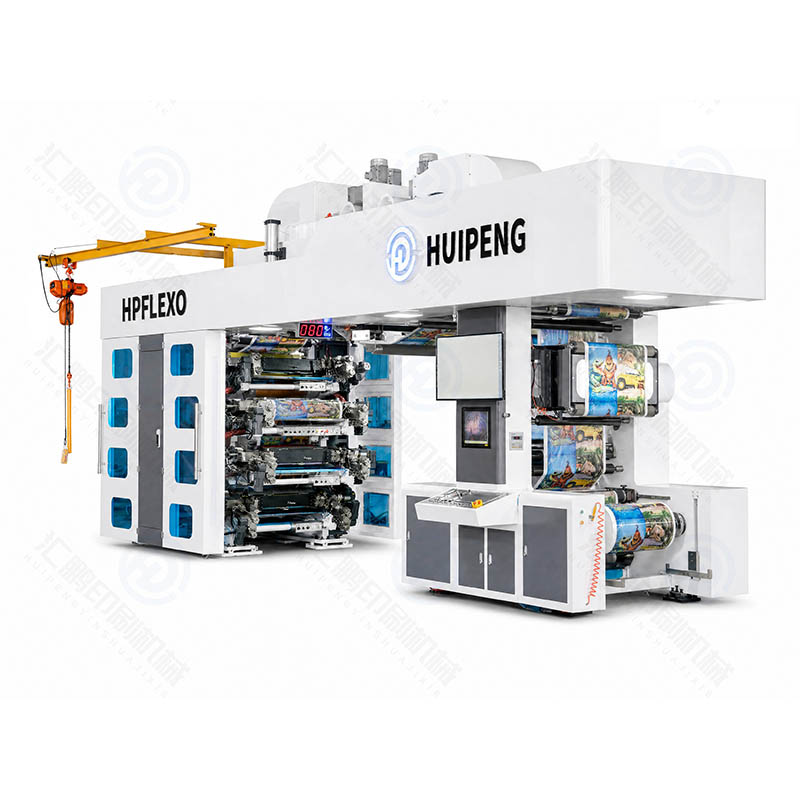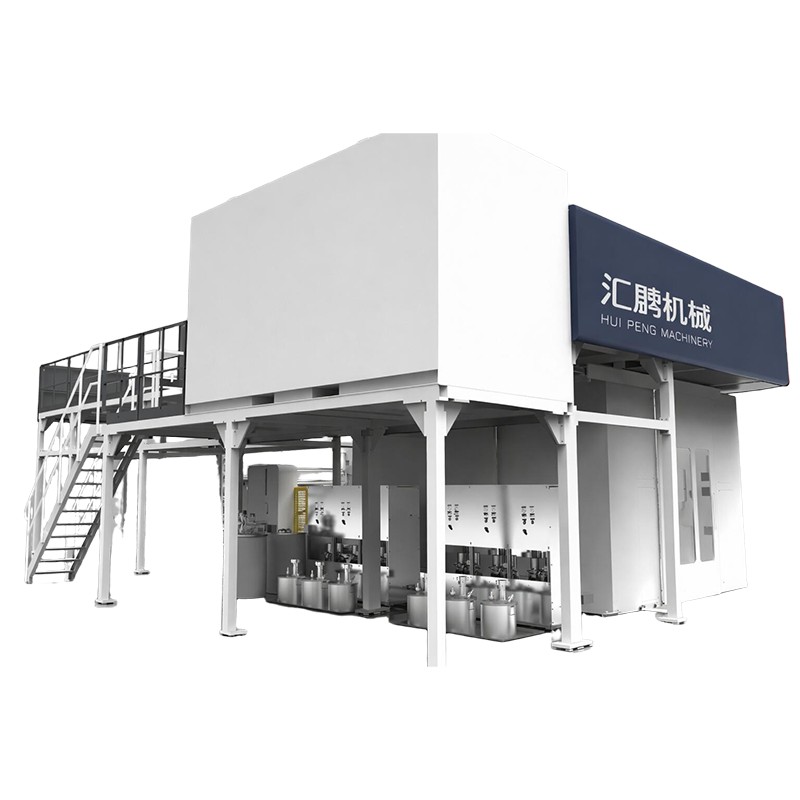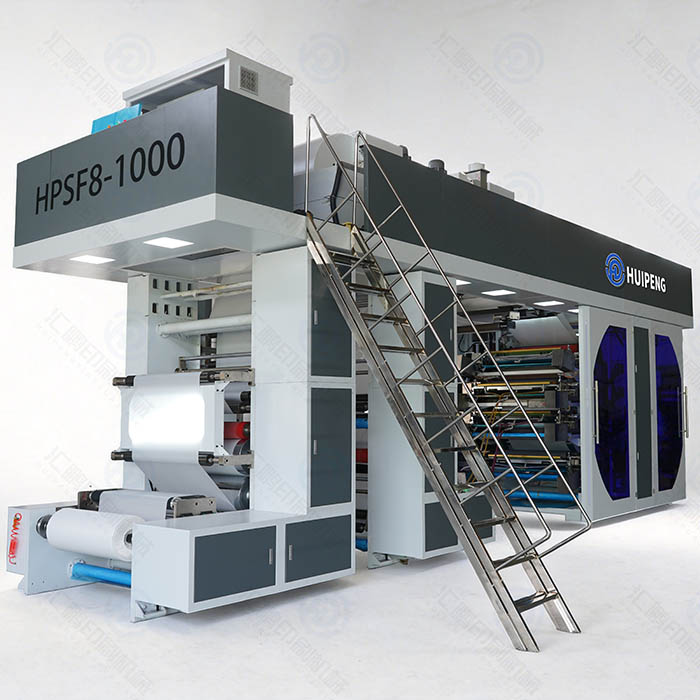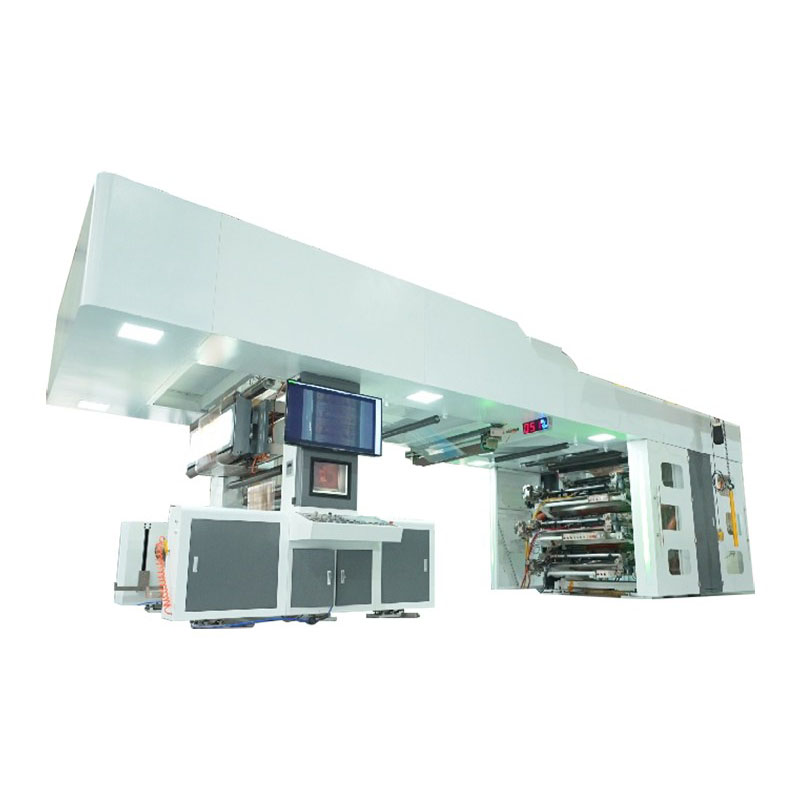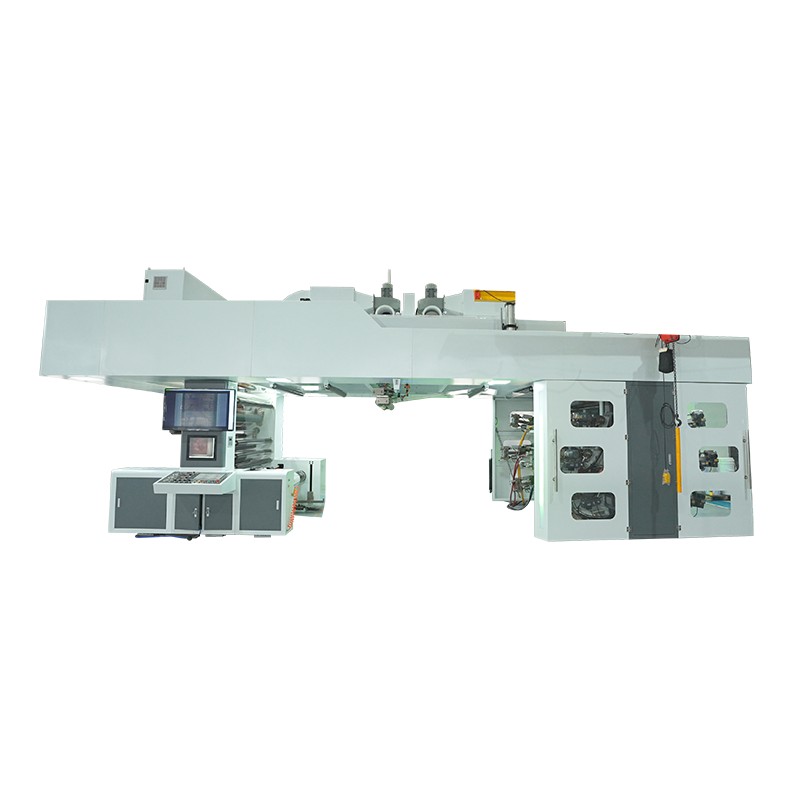

In flexible packaging, label, and folding carton production, converters are switching to shaftless servo architecture to eliminate gear backlash and cut changeover time. The Gearless flexographic press removes the main drive shaft and gear train, allowing each print station to stay perfectly synchronized with the web while running at its own controlled speed. This approach improves highlight dot reproduction, reduces banding, and lowers make-ready waste on short-run jobs. The Gearless flexo printing press is particularly effective on unsupported films, shrink sleeves, and pressure-sensitive label stocks because repeat length is set electronically rather than through mechanical gears. For higher automation, the Full servo flexo press provides independent servo motors on plate cylinder, anilox, and impression rolls, enabling rapid pre-registration and automatic print pressure adjustment. The Full servo flexographic printing machine extends this capability with integrated camera register control, closed-loop tension, and recipe-driven job storage, making it suitable for pharmaceutical, food, and health-care packaging that requires documented repeatability. Converters report that this shift reduces setup time by up to 40% compared with conventional geared presses. Because each deck is driven independently, there is no gear marking or cumulative pitch error, which translates into higher screen rulings and smoother vignettes. This architecture also reduces mechanical wear and lubrication requirements. Without drive shafts, couplings, and gearboxes, the press footprint becomes more compact and maintenance intervals extend beyond one year for bearings and drive components. For label converters running substrates such as BOPP, PE, PET, PVC, and aluminum foil, the full servo platform maintains consistent web tension even during acceleration and deceleration. Real-time position feedback from encoders on every axis ensures that each color station lands exactly on the target, reducing the need for manual register marks on every job. In addition, automatic impression settings compensate for sleeve run-out and substrate caliper variation, which keeps pressure uniform and extends plate life. Color management is simplified because the press can store anilox, plate, and ink data for each SKU, and inline spectrophotometers can be linked to the PLC for closed-loop color correction.
The shaftless flexo press is built around a rigid cast-iron or steel frame with modular printing units. Each unit carries a direct-drive servo motor, a precision linear guide system, and a sleeve-style mandrel for plate and anilox cylinders. This configuration supports quick sleeve changes, automatic washer positioning, and closed-loop web tension from a shaftless unwind to a servo rewind. Air-loaded chamber doctor blades and adjustable impression rolls help maintain stable ink film thickness across the full speed range. A cantilever design allows fast sleeve extraction, and the print decks can be pulled out for maintenance without affecting the web path. Each servo axis is synchronized over a deterministic EtherCat or CANopen network, so register corrections happen in real time. The machine handles both water-based and solvent-based inks, and the enclosed doctor chamber minimizes solvent evaporation. Operators can store repeatable job recipes that include impression pressure, dryer temperature, and register values, reducing human error during shift changes. Built-in web cleaners and corona treatment units can be installed before the first print station to improve adhesion on low-surface-energy films. The frame is pre-drilled for additional stations, and the modular design supports future conversion to screen or cold foil modules. The direct-drive motors are mounted directly on the sleeve mandrels, eliminating belts and pulleys that can introduce backlash. Each print unit has independent linear motors or ball-screw actuators for impression and side-lay adjustment, with absolute encoders for repeatable positioning. The chamber doctor system uses ceramic anilox sleeves with laser-engraved cell geometries from 120 lpi to 2000 lpi, depending on the ink and coating requirements. For solvent-based inks, the press can be configured with explosion-proof dryers and automatic viscosity control. The shaftless unwind and rewind use AC vector motors with load-cell feedback, allowing flying splice on non-stop configurations. HMI screens display real-time tension curves, register error, dryer temperatures, and production counts. The PLC stores up to 10,000 job recipes and supports OPC-UA for MES integration. Installation and commissioning typically require less than five working days, and training is provided by the manufacturer's service engineers. Critical spare parts are stocked in regional hubs to reduce downtime. The machine can be configured with a rail system for automatic sleeve handling, print deck wash-up, and robotic plate loading for higher-volume plants. All guarding meets CE safety standards, and the control architecture is compatible with Industry 4.0 data collection. Below are the main technical parameters and available options for the standard machine series.
| Parameter | Specification |
|---|---|
| Web width | 850 mm / 1050 mm / 1250 mm / 1450 mm |
| Repeat length | 280 mm - 800 mm (sleeve dependent) |
| Maximum mechanical speed | 400 m/min |
| Printing speed | Up to 300 m/min with hot air drying |
| Registration accuracy | ±0.05 mm at full speed |
| Substrate materials | BOPP, PE, PET, PVC, paper, foil, laminates |
| Substrate thickness | 20 μm - 200 μm |
| Unwind / rewind diameter | 1000 mm / 1200 mm (optional 1500 mm) |
| Drying options | Hot air, UV, LED-UV |
| Drive system | Direct-drive AC servo motors per deck |
| Power requirements | 380-440 V, 3-phase, 50/60 Hz |
| Control system | PLC with touchscreen HMI and remote access |